The Amazon of Dentistry
Amazon is the everything store.
Although initially branded as the internet's bookstore, Jeff Bezos always imagined a world where Amazon had every product people would ever want to buy.
This vision, and ultimately what Amazon has become to the consumer, is what Denta will become to the dentist. Dentists should be able to buy everything they need at the lowest possible price all in one place.
How does Denta get there
It is quite obvious that Denta can't start by being all things to all dentists. But Denta can start by providing the thing that dentists need most: patients.
Amazon's goal is to get their products from point A to point B in the most capital efficient way. Denta's goal is to get our patients to the dentist in the most capital efficient way.
Currently, most of the money in the dental ecosystem flows through insurance. To be exact, dental insurers collect $100B a year. These companies do not get their patients to the dentist in the most capital efficient way.
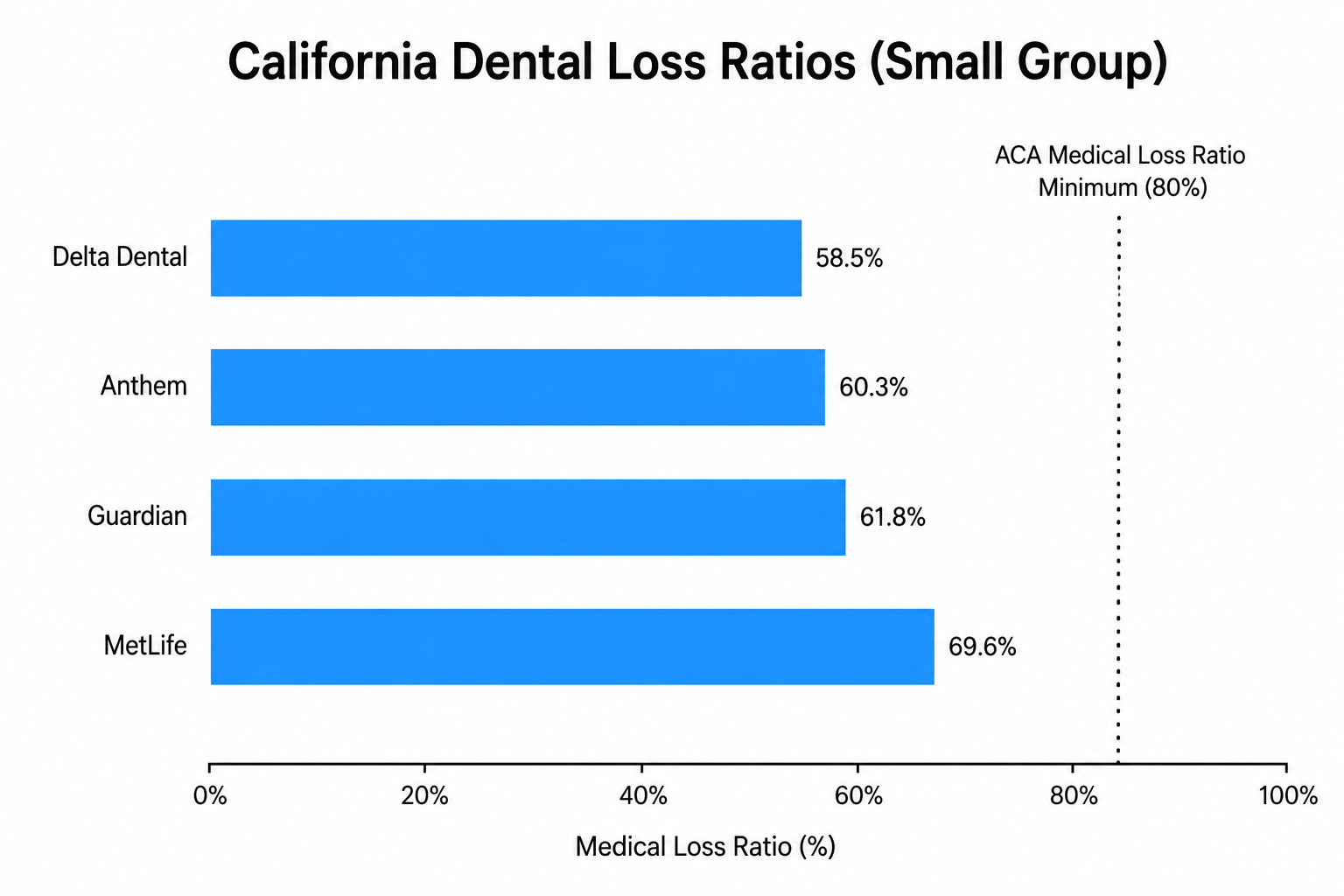
How do I know this? Here are the Small Group Dental Loss Ratios in California:
In case that terminology is unfamiliar:
Small group: A company with between 2-100 employees (in CA)
Loss ratio: The % of premiums that end up paying for the patient's care
Premiums: The monthly amount paid on behalf of the patient to the shared risk pool of the insurer
The Affordable Care Act mandates that health insurance companies have loss ratios greater than 80% for small groups. Meaning, if a health insurer does not spend 80% of premiums on care for their patients, they must refund the money to the employer. Yet, dental insurers get away with loss ratios as low as 58.5%.
Health insurance is a broken system in its own regard, but next to dental it doesn't look too bad. With these loss ratios, it costs $40B per year to insure patients and get them to the dentist. This can't possibly be the most cost effective way.
I know this because Denta does it for cheaper. Call centers, claims processing, clearinghouse fees, c-suite salaries, brokers, underwriters - all things that insurance companies had to pay for 30 years ago, Denta automates with AI.
But it is quite obvious Denta has a technology edge. Denta is a startup insurance company built to operate with AI, not a legacy incumbent desperately trying to come up with an AI plan. The real question is if that technology edge is big enough and will last long enough to overcome the existing network effects in the market. The largest dental insurers have the largest networks of dentists and the best distribution to employers. It is not obvious how Denta overcomes this.
Obsess over the dentist
The number one thing Denta needs to do, and will always need to do, is obsess over the dentist. In the same way Jeff Bezos says Amazon is relentlessly focused on the customer, Denta is relentlessly focused on the dentist. Why is this important for Denta? The relationship between the insurance company and dentist is what sets the cost of care for the patient and employer.
Insurance companies and dentists negotiate contracts to determine fees. A fee is the max amount a dentist can charge a patient of said insurance company for a given procedure. This is what it means for a dentist to be in-network with an insurance company. They negotiated rates and signed a contract. The patient now gets a discount when they go to one of these dentists. These negotiated fees are the juice of the entire market. The insurance company that wins is the one that negotiates the lowest fees with the greatest number of dentists.
That is because networks are the primary source of value that insurance companies sell to employers. As much as I complain about loss ratios, part of the 40% not spent on care is a luxury tax paid to the insurance companies for having the strongest networks. For Denta to compete, shaving administrative costs is not enough, Denta must build a better network.
Typically, insurance companies leverage their patient count with dentists to get lower fees and build a better network. Dentists know that if they don't become a part of Delta Dental's network, 30% of the American population will not come to their practice. Thus, Delta has all the leverage when negotiating with dentists.
But Denta does not have this leverage. As a startup, our patient base is small. We must leverage something else.
What we leverage is our relentless focus on making the dentist's life better. We can't bring our dentists millions of patients (yet), but we can pay them in real-time. We can give them free software. We can give them lower rates on dental supplies. We can become their Amazon.
To Denta, our network isn't just a number that we tell employers, it is why we became an insurance company. We are building a true network of dentists, a network where we prioritize serving them. We do this because we understand every dollar we can save a dentist is another dollar we can save an employer. We are willing to fight quite hard for each of those dollars.
The Everything Store
Denta will be the Amazon of Dentistry, the one place a dentist can go to buy any product or service at the lowest possible cost. To get access to this, all the dentist has to do is join Denta's network. This is our edge on legacy carriers. They build their networks by threatening to withdrawal their patients. We build our network by relentlessly serving the dentist. Service will always beat threats. Our network will beat theirs.
At that point, all that is left is for every employer to switch over to Denta when their plan resets on January 1. We will have the better network. We will have the lower costs. It is inevitable.
Denta is the new standard of dental care.
denta.com